I coloni hanno sparato a un palestinese e mutilato il suo corpo mentre giaceva morente Video
- Forze israeliane uccidono ufficiali palestinesi in una ‘missione sotto copertura’
- A Silwan, Gerusalemme, i coloni israeliani conducono un’altra battaglia per appropriarsi delle case dei palestinesi
- È apartheid, dicono gli ambasciatori di Israele in Sudafrica
- Coloni sparano ad un palestinese e ne mutilano il corpo mentre giace in fin di vita
- Che genere di resistenza fareste?
Basil al-Adraa e Yuval Abraham
8 giugno 2021 – +972 MAGAZINE
Testimoni affermano che dei coloni israeliani avrebbero sparato a Ismail Tubasi e lo avrebbero aggredito con oggetti appuntiti nel corso di una loro irruzione nel suo villaggio in Cisgiordania. Nessuna inchiesta è stata aperta.
Ismail Tubasi è stato ucciso venerdì 14 maggio, appena a sud di Hebron, nella Cisgiordania occupata. Tubasi, 27 anni, del villaggio palestinese di al-Rihiya, è stato trasportato gravemente ferito in un ospedale locale, dove ne è stato constatato il decesso.
Secondo le prove raccolte da Local Call [sito di notizie in lingua ebraica co-fondato e co-redatto da Just Vision e 972 Advancement of Citizen Journalism che pubblica anche +972 Magazine, ndtr.], sembra che Tubasi sia stato colpito con armi da fuoco da coloni israeliani, forse in compagnia di soldati, e dopo, mentre era a terra incapace di muoversi, brutalmente aggredito con oggetti appuntiti.
Secondo due testimoni i coloni avrebbero sparato a Tubasi dopo aver iniziato ad appiccare il fuoco a campi e alberi di proprietà palestinese ad al-Rihiya [città palestinese situata a sei chilometri a sud-ovest di Hebron, ndtr.]. I testimoni oculari hanno detto che Tubasi e altri palestinesi si sarebbero recati nei campi per cercare di spegnere le fiamme. Lì dei coloni armati di pistole, asce e bastoni avrebbero iniziato a inseguirlo, dopo di che i testimoni avrebbero sentito una serie di colpi di pistola.
Uno dei testimoni, il nipote di Tubasi, ha detto di aver visto suo zio steso a terra dopo che era stato colpito da un proiettile, ma non avrebbe notato nessuna ferita sul viso. Il nipote sarebbe poi fuggito dal luogo per paura che i coloni, che si stavano avvicinando a Tubasi ferito, se la prendessero anche con lui.
Tuttavia mezz’ora dopo, quando Tubasi è giunto in ospedale, il suo volto era sanguinante per ferite fresche e profonde, che non c’erano quando gli hanno sparato. Secondo la testimonianza, Tubasi sarebbe stato aggredito con un oggetto appuntito mentre non era in grado di muoversi.
Tubasi è stato trasportato all’ospedale Shaheed Abu Hassan al-Qassam nella città di Yatta, in Cisgiordania, dove ne è stato dichiarato il decesso. Secondo il referto dell’ospedale il corpo di Tubasi non aveva una ferita d’uscita del proiettile. Il referto dice anche che egli è stato ferito alla fronte da due oggetti appuntiti, uno lungo 20 centimetri e l’altro sette centimetri. Secondo il referto la causa della morte è stata un proiettile che ha colpito Tubasi alla testa. Il referto, che include una foto del corpo del deceduto, è stato visionato da Local Call e +972.
In Cisgiordania i coloni israeliani aggrediscono regolarmente i palestinesi, bruciano le loro coltivazioni e alberi e danneggiano le loro proprietà. Il gruppo per i diritti umani Yesh Din afferma di aver ricevuto 216 denunce di violenze compiute da coloni tra gennaio 2020 e giugno 2021. Un recente rapporto dell’organizzazione ha elencato 63 casi di gravi aggressioni tra il 2017 e il 2020. In nessuno di questi casi è stata avviata una procedura d’accusa contro gli aggressori.
L’esercito israeliano si è rifiutato di fornire una risposta ufficiale riguardo l’episodio, ma fonti militari hanno riferito alla Israeli Public Broadcast Corporation [l’emittente radiofonica e televisiva pubblica dello Stato di Israele, ndtr.] (che ha raccolto la storia in seguito alle indagini iniziali di Local Call) che i soldati sarebbero arrivati sul luogo dopo la sparatoria. Secondo le stesse fonti, l’esercito ha riferito alla polizia che un palestinese era stato effettivamente ucciso, ma la polizia deve ancora iniziare ad indagare.
Sebbene la brutale violenza dei coloni sia pervasiva è abbastanza raro che tali aggressioni conducano all’uccisione delle vittime. Secondo il gruppo per i diritti umani B’Tselem dal 2014 civili israeliani avrebbero ucciso 30 palestinesi residenti in Cisgiordania, molti dei quali durante presunti tentativi da parte di palestinesi di accoltellare israeliani o lanciare pietre contro veicoli israeliani.
Nel novembre 2017, ad esempio, i coloni hanno ucciso a colpi di arma da fuoco Mahmoud Za’al Odeh, del villaggio di Qusra [15 km a sud est di Nablus, ndtr.], sostenendo di essere stati attaccati con pietre mentre si trovavano sulla sua terra. Uno dei casi più infami di violenza mortale dei coloni è l’omicidio nel luglio 2015 dei membri della famiglia Dawabshe, bruciati vivi nelle loro case nel villaggio di Duma mentre dormivano.
La morte di Tubasi è avvenuta in un giorno di manifestazioni di massa in tutta Israele-Palestina, compresa la Cisgiordania, per protestare contro gli attacchi israeliani a Gaza e le violenze contro i cittadini palestinesi all’interno di Israele. Secondo il ministero della Sanità palestinese, quel giorno le forze di sicurezza israeliane [l’esercito israeliano, ndtr.] avrebbero ucciso in varie località della Cisgiordania 11 palestinesi. Sulla base di testimonianze palestinesi gruppi di coloni, spalleggiati da un piccolo numero di soldati, avrebbero assaltato, oltre che al-Rihiya, quattro villaggi in Cisgiordania: Urif, Asira al-Qabliya, Eskaka e Marda. La morte di Tubasi per mano dei coloni smentisce l’affermazione del ministero della Sanità palestinese che attribuiva ai soldati israeliani la responsabilità della morte degli 11 palestinesi.
Secondo gli amministratori di queste quattro località, gli assalti dei coloni hanno portato a scontri di massa e all’uso di armi da fuoco contro palestinesi da parte sia dei coloni che dei soldati. Secondo quanto riferito quattro giovani palestinesi, uno in ogni località, sarebbero stati uccisi in questo modo mentre decine di altri palestinesi sarebbero rimasti feriti. “Sono venuti per uccidere”, ha detto Hafez Saleh, l’amministratore di Asira al-Qabliya.
“L’esercito ha visto tutto, ma non è intervenuto”
Secondo tre testimoni oculari con cui ha parlato Local Call, il 14 maggio alle 14 diverse decine di coloni sarebbero arrivati dalla direzione di Beit Hagai, una colonia israeliana situata a 700 metri da al-Rihiya, e avrebbero iniziato ad incendiare i campi e gli alberi del villaggio, entrando persino nell’abitato. Gli abitanti del villaggio li avrebbero identificati come coloni in quanto vestiti da civili, con addosso la kippah e alcuni con riccioli sui lati del volto. Gli abitanti del villaggio hanno detto che quando hanno cercato di spegnere il fuoco sarebbero stati picchiati dai coloni. I soldati israeliani sarebbero arrivati sul posto senza intervenire.
“Mi sono svegliato a casa con la gente che urlava: ‘Al fuoco, hanno appiccato un fuoco’”, ricorda Kazem al-Hallaq, un abitante di Al-Rihiya di 62 anni. “Sono uscito e ho visto un grande incendio nella zona degli ulivi e dei campi di grano e di orzo. La fonte dell’incendio era a nord, cioè nella direzione di Beit Hagai. Molti coloni, circa 50 persone, stavano nei pressi delle fiamme. Hanno continuato ad appiccare il fuoco ai campi e si sono assicurati che bruciassero e che le fiamme si diffondessero”.
Al-Hallaq riferisce di aver visto due giovani della sua famiglia che cercavano di spegnere il fuoco con delle coperte, ma subito ha visto i coloni correre verso di loro e picchiarli, e ad un certo momento gettarli a terra. “I soldati si tenevano lontani. Hanno visto tutto, ma non sono intervenuti”, dice al-Hallaq.
“Quando sono arrivati altri palestinesi per spegnere l’incendio, l’esercito è intervenuto e ha iniziato a sparargli contro lacrimogeni e proiettili di gomma”, ha continuato al-Hallaq. “La maggior parte delle persone è fuggita verso le proprie case e la scuola. I coloni li hanno inseguiti, proprio davanti ai soldati, sono entrati nel villaggio e hanno iniziato a lanciare pietre contro le case.
“I coloni sono venuti proprio a casa mia e hanno distrutto l’auto parcheggiata all’ingresso. E’ stato spaventoso. Ho chiuso la porta di casa e sono salito sulla terrazza con i bambini per nasconderli. Mentre stavo nascosto sul tetto i coloni sono saliti sulla mia auto e hanno iniziato a ballare e cantare.
“Improvvisamente ho visto un altro gruppo di coloni che si stava dirigendo verso la terra che appartiene alla famiglia Tubasi. Era difficile vedere cosa stesse succedendo lì. Ho visto un fumo denso salire dal terreno e mi sono reso conto che i coloni avevano dato fuoco a un altro campo. Pochi minuti dopo ho sentito cinque colpi di pistola, spari di armi da fuoco. Ho visto gli abitanti del villaggio correre lì e ho sentito il suono di un’ambulanza che si avvicinava.
“A un certo punto sono anche uscito di casa e sono andato a vedere cosa fosse successo”, dice al-Hallaq. “C’era molta confusione. Alcune persone sostenevano che qualcuno era morto. Altri dicevano che qualcuno era stato ferito. Dopo un’ora mi è stato detto che un giovane della famiglia Tubasi era stato ucciso. I nostri campi erano completamente bruciati. I coloni e l’esercito scomparsi dalla zona”.
“I coloni ci hanno detto con orgoglio di aver bruciato i nostri campi”
“A mezzogiorno di venerdì, mi ha chiamato mio zio Ismail”, riferisce Jamal Tubasi, nipote della vittima. “Ero a casa di mia zia per la festa di Eid al-Fitr [festività che segna la fine del periodo di digiuno del Ramadan, ndtr.]. Ismail era sconvolto e mi ha chiesto di andare subito. Ho chiesto dove, e lui ha detto: ‘All’uliveto, a nord del paese. I coloni stanno bruciando i nostri campi, le fiamme sono forti.’
“Sono corso subito lì, a circa un chilometro e mezzo da casa”, prosegue Jamal. “Quando sono arrivato ho visto un grande gruppo, 30 coloni, la maggior parte dei quali giovani, rannicchiati a circa 200 metri dagli ulivi in fiamme. I coloni ci hanno detto con orgoglio di aver incendiato i nostri campi. E non solo i nostri campi, ma anche il resto.
“Ismail mi ha riferito che [gli abitanti dei villaggi palestinesi] stavano cercando da molto tempo di spegnere l’incendio, ma i coloni glielo impedivano. Ho visto giungere sul posto altri gruppi di coloni, alcuni con grandi accette in mano, altri con armi da fuoco e bastoni. Accanto ai coloni c’erano anche i soldati.
“Gli uomini più giovani, e con loro Ismail, hanno cercato di dirigersi verso il fuoco negli uliveti, ma i soldati hanno sparato contro di loro gas lacrimogeni, proiettili di gomma e granate stordenti. I coloni stavano dietro ai soldati e cercavano di avanzare verso di noi per attaccarci. Ismail mi ha chiesto di stargli vicino. Ma è diventato terribile quando è aumentata la quantità di gas lacrimogeni e granate stordenti e i coloni insieme ai soldati sono riusciti ad avvicinarsi molto a noi. Siamo scappati e ci siamo divisi in gruppi più piccoli.
“Ho visto che mio zio Ismail era corso verso gli uliveti. In quel momento ho ricevuto una chiamata, ho risposto al telefono; era un parente che voleva sincerarsi che io e Ismail stessimo bene. Finita la chiamata, non sono riuscito a distinguere dove fosse andato Ismail.
“È stato allora che ho sentito degli spari. Più di cinque proiettili. Da arma da fuoco. Non capivo cosa fosse successo. Una persona si è avvicinata e ha urlato “Ismail è stato ferito”. Ha indicato la direzione in cui Ismail era fuggito, a 300 metri da dove mi trovavo io”.
Il fratello di Ismail, Ibrahim, era al suo fianco mentre andavano a spegnere l’incendio nei campi di famiglia. “I soldati hanno sparato lacrimogeni, granate stordenti e proiettili di gomma per dividerci”, riferisce Ibrahim. “Ero accanto a Ismail e l’ho visto correre verso gli alberi [di ulivi]. Ho corso nella direzione opposta. Ho visto un gruppo di coloni correre nella direzione in cui era fuggito Ismail, e poi ho avvertito quattro spari. Non ho capito né ho visto chi avesse aperto il fuoco, ma il suono proveniva dalla direzione in cui Ismail era fuggito. Ho sentito alcuni abitanti dire che Ismail era stato ferito”.
Secondo testimonianze di palestinesi che hanno chiesto che non venisse reso noto il loro nome, sono stati i coloni ad aprire il fuoco e non i soldati, che erano rimasti nei pressi del villaggio.
«Hanno ucciso mio fratello. La nostra terra è bruciata’
Jamal Tubasi, nipote di Ismail, riferisce di essere poi corso dove Ismail era stato colpito. “Ho visto Ismail steso a terra tra due rocce, sul fianco destro. Quando mi ha visto, mi ha chiamato con voce molto debole. Quasi in un sussurro mi ha detto: “Sono ferito”, poi mi ha dato il suo telefono e mi ha chiesto di consegnarlo alla famiglia. «appoggia a terra la mia testa», ha sussurrato Ismail, «e fuggi il più in fretta possibile.» Gli ho detto che non l’avrei lasciato, ma lui ha sollevato la mano con grande difficoltà, mi ha guardato e mi ha detto di nuovo, con un voce molto flebile: ‘Corri.’”
“In quel momento ho visto un gruppo di cinque coloni che avevano con sé grandi accette, e accanto a loro due soldati, tutti che correvano verso di noi. Erano a circa 50 metri da me e si stavano avvicinando rapidamente. Sotto pressione, ho girato Ismail sulla schiena e sono scappato. Quando l’ho lasciato, il suo naso sanguinava e sanguinava anche dall’orecchio sinistro. A parte questo, il suo viso sembrava a posto. Non riuscivo a capire quale fosse la natura della sua ferita e se fosse in condizioni gravi o lievi.
“Ho corso per 200 o 300 metri. Da dove mi trovavo ho visto persone che cercavano di raggiungere l’area in cui era caduto Ismail. Andavano avanti e indietro, come se cercassero qualcosa. È passato molto tempo, è difficile per me dire quanto, più di mezz’ora. Poi ho visto tre o quattro persone, operatori sanitari, che trasportavano Ismail su una barella.
“Sono corso lì e ho chiesto loro di vedere Ismail per assicurarmi che fosse vivo. Hanno abbassato la barella e poi ho visto la sua faccia. Non potevo crederci: il suo volto era completamente devastato, con ferite profonde, coperto di sangue che colava dappertutto. Non potevo sopportarne la vista. Ho urlato di terrore e sono caduto a terra privo di sensi.
“Tutto quello che ricordo dopo è che la gente mi ha versato dell’acqua in faccia, e altri mi hanno sollevato le gambe e mi hanno schiaffeggiato per svegliarmi. Quando mi sono svegliato mi è stato detto che avevano portato Ismail all’ospedale di Yatta.
“Un’auto mi ha portato in ospedale. E quando sono arrivato, ho sentito due persone che dicevano che Ismail era morto. Sono svenuto di nuovo. Mi sono svegliato e sono svenuto ancora. Sinceramente il mio corpo non si è riavuto dallo shock e faccio fatica a credere a quello che è successo.
“L’unica cosa di cui sono sicuro è che quando ho raggiunto mio zio, appena dopo il suo ferimento, la sua faccia era pulita, non c’era niente lì, solo sangue che gli colava dal naso e dall’orecchio. E ricordo che il gruppo di coloni che correva verso Ismail insieme a due soldati trasportava delle accette».
Altri abitanti di al-Rihiya hanno riferito che i coloni avrebbero circondato Ismail mentre giaceva a terra, rendendo loro difficile valutare con esattezza le modalità dell’aggressione.
“La mia famiglia è devastata”, dice Ibrahim, il fratello di Ismail. “Hanno assassinato mio fratello. La nostra terra è bruciata. Non siamo in grado di tornare lì per controllare. Di solito i coloni vengono di notte e sradicano gli ulivi, ma questa volta l’esercito ha approfittato della situazione e i coloni si sono sentiti più forti e incoraggiati del solito, tanto da incendiare tutto e assassinare mio fratello”.
Ibrahim aggiunge: “Oggi non c’è differenza tra un soldato e un colono. Questa gente ci ha distrutto. Due giorni dopo l’omicidio di mio fratello, l’esercito ha revocato i nostri permessi di lavoro in Israele. Cinque uomini della mia famiglia lavorano in Israele. Ora viene impedito a tutti noi di entrare».
La famiglia Tubasi ha dichiarato di aver sporto denuncia alla polizia palestinese dopo la morte di Ismail. Non è chiaro se la polizia palestinese abbia inoltrato la denuncia alla polizia israeliana. Tuttavia, se l’esercito ha effettivamente informato la polizia israeliana che Ismail è stato ucciso, non si capisce come la polizia non abbia aperto la propria indagine indipendentemente dal fatto che sia stata presentata una denuncia, come prevede la legge israeliana per un sospetto di crimine e specialmente nei casi di morte non naturale.
In relazione all’uccisione la polizia israeliana ha rilasciato solo la seguente risposta: “Nessuna denuncia è stata presentata alla polizia e i dettagli dell’incidente nei termini dichiarati non ci sono noti. Potete contattare la polizia e sporgere denuncia come di consueto”.
Basil al-Adraa è un attivista e fotografo del villaggio di a-Tuwani nelle colline a sud di Hebron.
Yuval Abraham è uno studente di fotografia e linguistica.
(traduzione dall’inglese di Aldo Lotta)
Questo articolo è stato pubblicato per la prima volta in ebraico su Local Call. Leggilo qui .

972MAG.COM
Settlers shot Palestinian and mutilated his body as he lay dying
Eyewitnesses say Israeli settlers shot Ismail Tubasi and attack
Witnesses say Israeli settlers shot Ismail Tubasi and attacked him with sharp objects while raiding his West Bank village. No investigation was opened.
By Basil al-Adraa and Yuval Abraham June 8, 2021
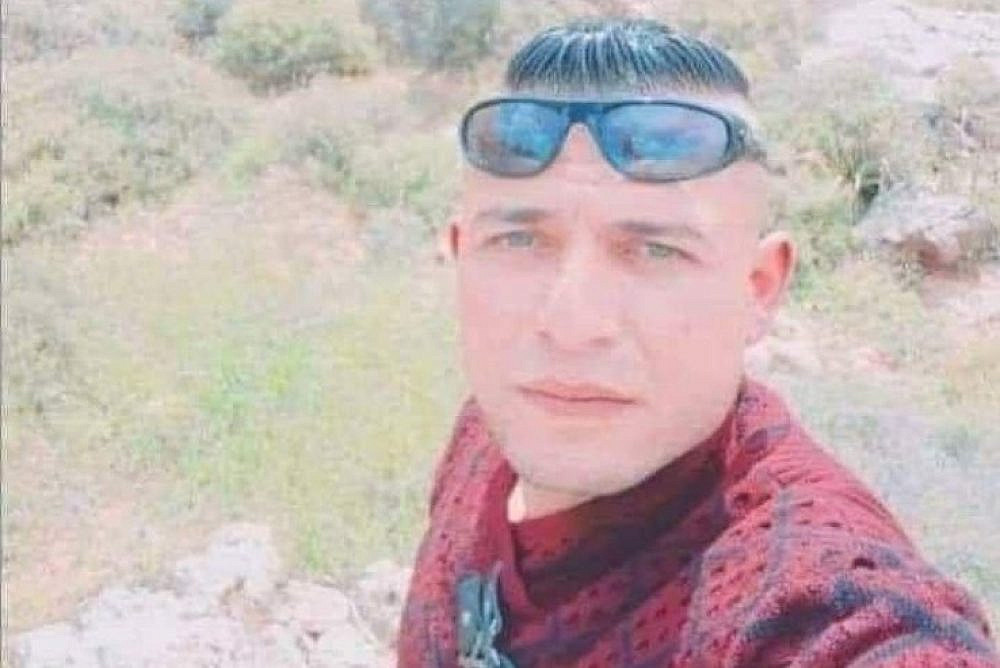
Ismail Tubasi (Courtesy of the Tubasi family)
Ismail Tubasi was shot on Friday, May 14, just south of Hebron in the occupied West Bank. Tubasi, 27, from the Palestinian village of al-Rihiya, was transferred to a local hospital with severe wounds, where he was pronounced dead.
According to evidence gathered by Local Call, it appears Tubasi was shot by Israeli settlers, who may have been accompanied by soldiers, after which he was brutally attacked with sharp objects as he lay incapacitated.
According to two witnesses, settlers shot Tubasi after they began setting fire to Palestinian-owned fields and trees in al-Rihiya. The eyewitnesses said Tubasi and other Palestinians had headed to the fields to try and put out the flames. There, settlers armed with guns, axes, and batons began chasing him, after which the witnesses heard a number of gunshots.One of the witnesses, Tubasi’s nephew, said that he saw his uncle laying on the ground after being hit by a bullet, yet did not see any wounds on his face. The nephew then fled the scene out of fear that the settlers, who were approaching the wounded Tubasi, would come after him next.
When Tubasi was evacuated to a hospital half an hour later, however, his face was bloodied by fresh and deep wounds, which were not there when he was shot. According to the testimony, Tubasi was allegedly attacked by a sharp object while incapacitated.
Tubasi was evacuated to Shaheed Abu Hassan al-Qassam Hospital in the West Bank city of Yatta, where he was pronounced dead. According to the hospital report, Tubasi’s body did not have an exit wound from the bullet. The report also said that he was wounded in his forehead by two sharp objects, one of them 20 centimeters long and the other seven centimeters. According to the report, the cause of death was a bullet that struck Tubasi’s head. The report, which included a photo of the deceased body, was viewed by Local Call and +972.
Israeli settlers in the West Bank routinely attack Palestinians, burn their crops and trees, and damage their property. Human rights group Yesh Din say they received 216 complaints of settler violence between January 2020 and June 2021. A recent report by the organization listed 63 cases of severe assaults between 2017 and 2020. In none of these cases was an indictment filed against the attackers.
The Israeli army refused to provide an official response to the incident, but military sources told the Israeli Public Broadcast Corporation (which picked up the story following Local Call’s initial investigation) that the soldiers arrived at the scene after the shooting. According to the same sources, the army reported to the police that a Palestinian had indeed been shot dead, yet the police has yet to open its own investigation.
Although brutal settler violence is pervasive, it is quite rare for such attacks to lead to the killings of victims. According to human rights group B’Tselem, since 2014, Israeli civilians have killed 30 Palestinian residents of the West Bank, many of them during alleged attempts by Palestinians to stab Israelis or throw stones at Israeli vehicles.
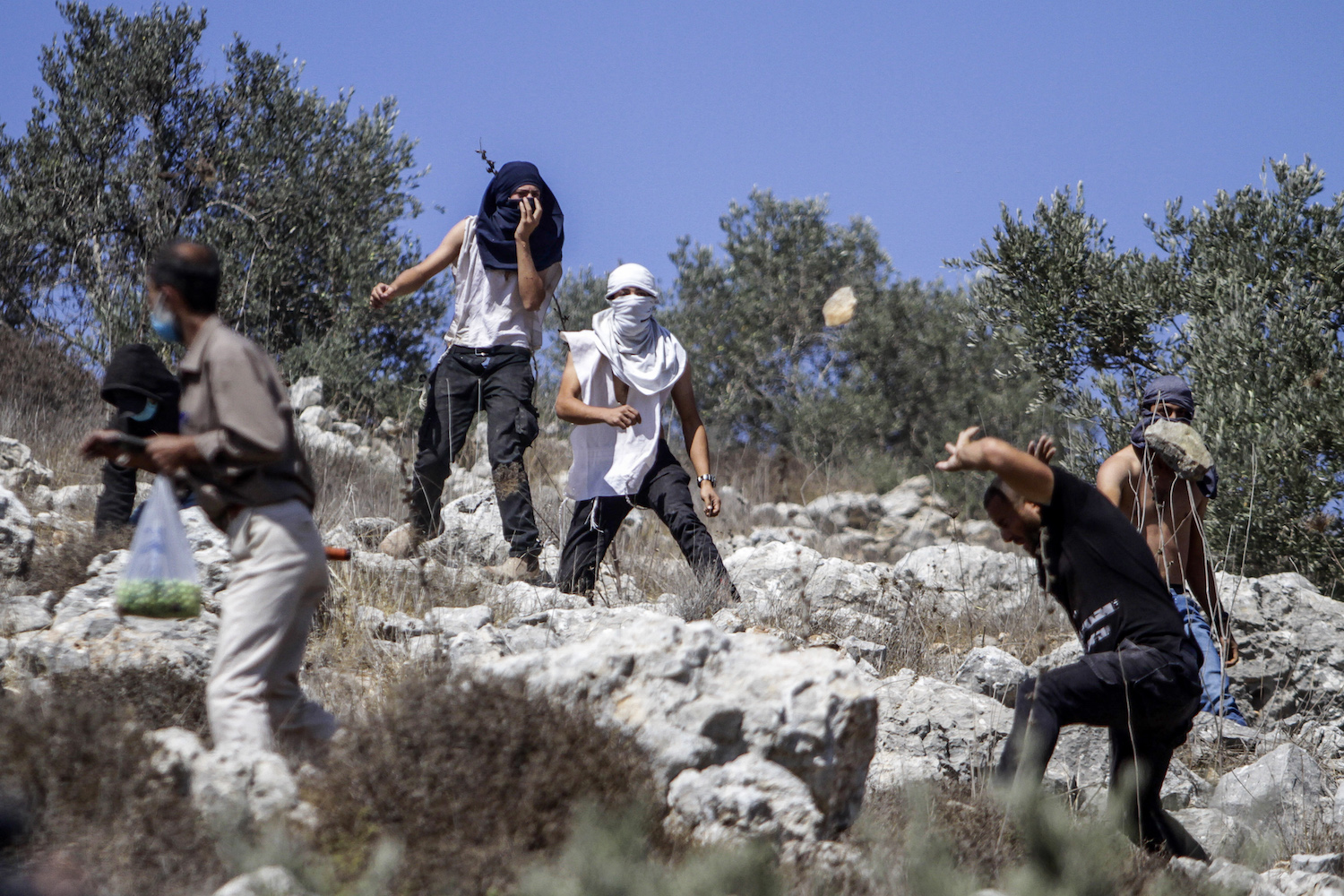
Illustrative photo of Israeli settlers hurling stones at Palestinians during the annual harvest season in the West Bank. (Nasser Ishtayeh/Flash90)
In November 2017, for example, settlers shot dead Mahmoud Za’al Odeh, from the village of Qusra, claiming they were attacked with stones while they were on his land. One of the most infamous cases of deadly settler violence is the murder of members of the Dawabshe family in July 2015, who were burned alive in their homes in the village of Duma as they slept.
Tubasi’s death took place on a day of mass demonstrations across Israel-Palestine, including the West Bank, in protest of Israeli attacks on Gaza and violence against Palestinian citizens inside Israel. According to the Palestinian Health Ministry, Israeli security forces killed 11 Palestinians that day in various locations around the West Bank. According to Palestinian testimonies, besides al-Rihiya, groups of settlers, backed by a small number of soldiers, attacked four villages in the West Bank: Urif, Asira al-Qabliya, Eskaka, and Marda. Tubasi’s death at the hands of settlers refutes to Palestinian Health Ministry’s claim that Israeli soldiers were responsible for the deaths of the 11 Palestinians.
According to the heads of these four localities, the settler attacks led to a massive confrontation and the use of live fire against Palestinians from both settlers and soldiers. Four young Palestinians were reportedly killed in this manner, one in each locality, while dozens of other Palestinians were wounded. “They came to kill,” said Hafez Saleh, the head of Asira al-Qabliya.
‘The army saw everything, but did not intervene’
According to three eyewitnesses Local Call spoke to, on May 14 at 2 p.m., several dozen settlers arrived from the direction of Beit Hagai, an Israeli settlement located 700 meters from al-Rihiya, and began burning the village’s fields and trees, even entering the locality. The villagers identified them as settlers because they were dressed as civilians, wore kippahs, and some had sidelocks. The villagers said that when they tried to put out the fire, they were beaten by the settlers. Israeli soldiers arrived at the scene but did not intervene.
“I woke up at home to people screaming: ‘Fire, they set a fire,'” recalls Kazem al-Hallaq, a 62-year-old resident of Al-Rihiya. “I went outside and saw a large fire in the area of the olive trees, and the wheat and barley fields. The source of the fire was from the north, that is, from the direction of Beit Hagai. Many settlers stood by the fire, about 50 people. They continued to set fire to the fields and made sure it burned and spread.”
Al-Hallaq said that he saw two young men from his family who tried to put out the fire with blankets, but as soon as they started, he saw settlers running toward them and beating them, and at one point knocking them to the ground. “The army stood far away. They saw everything, but did not intervene,” al-Hallaq said.
“When more Palestinians arrived to put out the fire, the army intervened and began throwing gas grenades and firing rubber bullets at them,” al-Hallaq continued. “Most of the people fled to their homes and to the school. The settlers followed them, right in front of the soldiers, entered the village and began throwing stones at the homes.
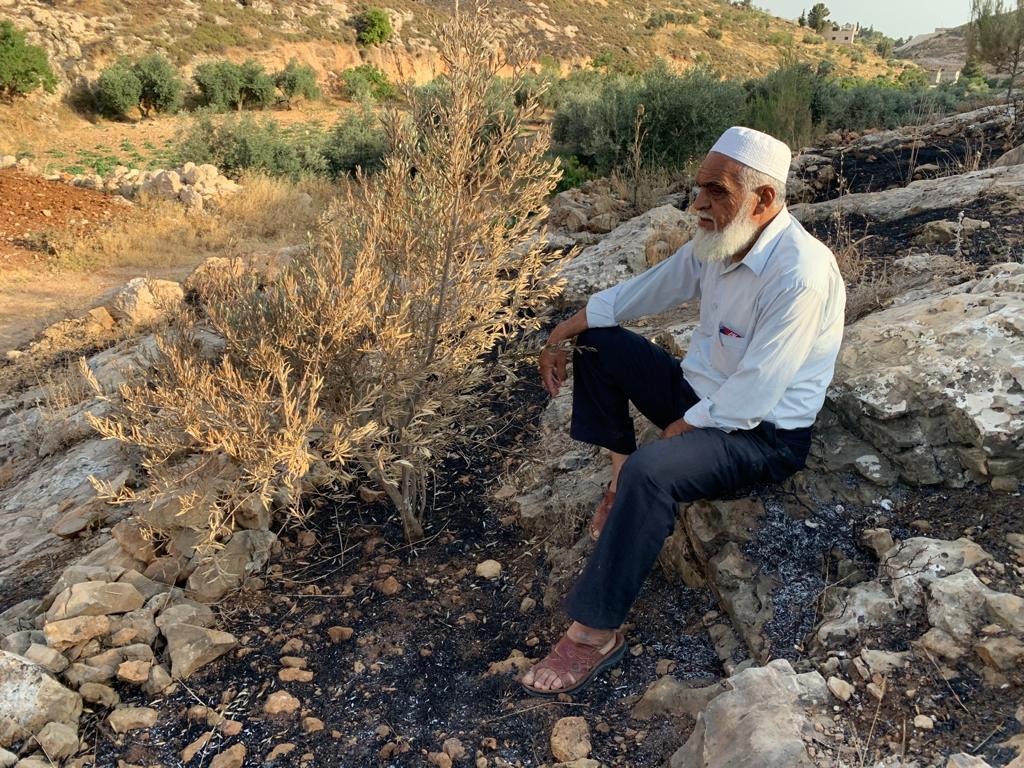
Kazem al-Hallaq. (Basil al-Adraa)
“Settlers came right up to my house and smashed the car parked at the entrance. It was scary. I locked the door of the home, and went up to the roof with the children to hide them. The settlers stepped onto my car and started dancing and singing while I hid on the roof.
“Suddenly, I saw another group of settlers who were heading to the land that belongs to the Tubasi family. It was difficult to see what was happening there. I saw thick smoke rising from the ground and realized that the settlers had set fire to another field. A few minutes later I heard five gunshots, live fire. I saw residents of the village running there, and heard the sound of an ambulance approaching.
“At one point I also left the house and went to see what had happened,” said al-Hallaq. “There was a lot of confusion. Some people said that someone was dead. Others said someone had been wounded. After an hour I was told that a young man from the Tubasi family was killed. Our fields were completely burned. The settlers and the army disappeared from the area.”
‘The settlers proudly told us they burned our fields’
“At noon on Friday, my uncle Ismail called me,” said Jamal Tubasi, the victim’s nephew. “I was at my aunt’s house because of the Eid al-Fitr holiday. Ismail was stressed and asked me to come quickly. I asked where, and he said: ‘To the olive trees, in the north of the village. The settlers are burning our fields, the fire is strong.’
“I quickly ran there, about a mile from the house,” Jamal continued. “When I arrived I saw a large group, 30 settlers, most of them young, huddled about 200 meters from the burning olive trees. The settlers proudly told us they burned our fields. And not just our fields, but all over.
“Ismail told me that [Palestinian villagers] had been trying to put out the fire for a long time, but settlers were preventing them. I saw other groups of settlers who came to the place, some holding large axes in their hands, some armed with weapons and batons. The soldiers also stood there near the settlers.
“Our young men, and with them Ismail, tried to head to the fire in the olive groves, but the soldiers fired tear gas, rubber bullets, and stun grenades at them. The settlers stood behind the soldiers and tried to advance toward us to attack us. Ismail asked me to stay close to him. But it became very scary once the amount of tear gas and stun grenades increased, and the settlers managed to get very close to us along with the soldiers. We ran away and split into smaller groups.
“I saw that my uncle Ismail had run toward the olive groves. At that moment I got a call, I answered the phone; it was a relative who wanted to check that Ismail and I were okay. When I was done with the call, I could not see where Ismail had gone.
“That’s when I heard gunshots. More than five bullets. Live fire. I didn’t understand what happened. One person came over and yelled ‘Ismail was wounded.’ He pointed over at the direction where Ismail had fled, 300 meters from where I stood.”
Ismail’s brother, Ibrahim, was by his side as they went to put out the fire in the family’s fields. “The soldiers fired gas, stun grenades, and rubber bullets to cause us to split up,” Ibrahim said. “I was standing next to Ismail and I saw him run toward the [olive] trees. I ran in the opposite direction. I saw a group of settlers running in the direction where Ismail fled to, and then I heard about four shots. I did not know or see who opened fire, but the sound came from where Ismail fled. I heard some residents say that Ismail was wounded.”
According to testimonies of Palestinians who asked not to be identified by name, it was the settlers who had opened fire, rather than the soldiers who had been standing closer to the village.
‘They murdered my brother. Our land is burned’
Jamal Tubasi, Ismail’s nephew, says he then ran to where Ismail had been shot. “I saw Ismail lying on the ground between two rocks, on his right side. When he saw me, he called to me in a very weak voice. Almost in a whisper he told me, ‘I’m wounded,’ then he gave me his phone and asked me to take it to the family. ‘Put my head on the ground,’ Ismail murmured, ‘and run away as fast as possible.’ I told him I would not leave him, but he raised his hand with great difficulty, looked at me, and said again, in a very weak voice: ‘Run.’”
“At that moment I saw a group of five settlers carrying large axes, and next to them were two soldiers, all running toward us. They were about 50 meters away from me and approaching quickly. Under pressure, I flipped Ismail on his back and ran away. When I left him, his nose was bleeding and he was also bleeding from his left ear. Apart from that, his face looked fine. I could not understand what the nature of his injury was, and whether he was in serious or mild condition.
“I ran 200 or 300 meters away. From where I was standing I saw people trying to get to the area where Ismail fell. They went back and forth, as if they were looking for something. A long time passed, it’s hard for me to say how much, more than half an hour. Then I saw three or four people, medical workers, carrying Ismail on a stretcher.
“I ran there and asked them to see Ismail to make sure he was alive. They lowered the stretcher and then I saw his face. I could not believe it: his face was completely broken, with deep wounds, covered in blood that was dripping everywhere. I could not bear to look. I screamed in terror, fell to the ground, and fainted.
WATCH: Ismail Tubasi taken to hospital after being shot

“All I remember after that is that people poured water on my face, and others lifted my legs up, and slapped me to wake me up. When I woke up, I was told they had taken Ismail to the hospital in Yatta.
“A car took me to the hospital. And when I arrived, I heard two people say that Ismail was dead. I fainted again. I woke up and fainted again. Truthfully, the shock has not left my body and I have a hard time believing what happened.
“The only thing I’m sure about is that when I got to my uncle, after his first injury, his face was clean, there was nothing there, only blood dripping from his nose and ear. And I remember that the group of settlers who ran to Ismail with two soldiers were carrying axes.”
Other residents of al-Rihiya said settlers surrounded Ismail as he lay on the ground, making it difficult for them to gauge exactly how he was attacked.
“My family is devastated,” said Ismail’s brother, Ibrahim. “They murdered my brother. Our land is burned. We are not able to go back there to see it. Usually the settlers come at night and uproot olive trees, but this time the army took advantage of the situation, and the settlers felt they had more power and support than usual to burn everything and murder my brother.”
Ibrahim added, “Today there is no difference between a soldier and a settler. These people destroyed us. Two days after my brother’s murder, the army revoked our work permits in Israel. Five men from my family work in Israel. Now we are all prevented from entering.”
The Tubasi family said they had lodged a complaint with the Palestinian police following Ismail’s death. It is not clear whether the Palestinian police forwarded the complaint to the Israeli police. Yet if the army did in fact inform the Israeli police that Ismail was killed, it is not clear why the police did not open its own investigation regardless of whether a complaint was filed, as per Israeli law in suspected crimes, and especially in cases of unnatural death.
Israeli police offered only the following response to the killing: “No complaint was filed with the police and the details of the incident as stated are not known to us. You can contact the police and file a complaint as is customary.”
This article was first published in Hebrew on Local Call. Read it here.
Commenti
Posta un commento