Peter Beinart Gaza — And The Truth

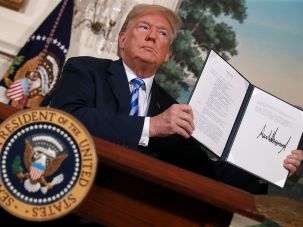
Abandoning Iran Deal, U.S. Joins Israel In Axis Of Escalation
The first West champions diplomacy based on mutual compromises between longtime adversaries. The second champions “maximum pressure”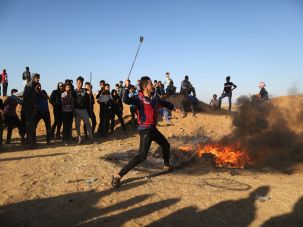
Abandoning Iran Deal, U.S. Joins Israel In Axis Of Escalation
The first West champions diplomacy based on mutual compromises between longtime adversaries. The second champions “maximum pressure”American Jews Have Abandoned Gaza — And The Truth – The Forward
Peter Beinart for a Twitter
conversation about this piece with the hashtag #ForwardIsraelChat on Tuesday,
5/1, at 5pm.
“In our time,” wrote George Orwell in 1946, “political speech and writing are largely the
defense of the indefensible.” British colonialism, the Soviet gulag and
America’s dropping of an atomic bomb, he argued, “can indeed be defended, but
only by arguments which are too brutal for most people to face.” So how do
people defend the indefensible? Through “euphemism, question-begging and sheer
cloudy vagueness.” By obscuring the truth.
So it is, more than 70 years
later, with Israeli policy toward the Gaza Strip. The truth is too brutal to
honestly defend. Why are thousands of Palestinians risking their lives by
running toward the Israeli snipers who guard the fence that encloses Gaza?
Because Gaza is becoming uninhabitable. That’s not hyperbole. The United
Nations says that Gaza will be “unlivable” by 2020, maybe sooner.
Hamas bears some of the blame
for that: Its refusal to recognize Israel, its decades of terrorist attacks and
its authoritarianism have all worsened Gaza’s plight. Mahmoud Abbas’s
Palestinian Authority bears some of the blame too. So does Egypt.
But the actor with the
greatest power over Gaza is Israel. Israeli policies are instrumental in
denying Gaza’s people the water, electricity, education and food they need to
live decent lives.
How do kind, respectable,
well-meaning American Jews defend this? How do they endorse the strangulation
of 2 million human beings? Orwell provided the answer. They do so because
Jewish leaders, in both Israel and the United States, encase Israel’s actions
in a fog of euphemism and lies.
The fog consists, above all,
of three words — “withdrew,” “security” and “Hamas” — which appear to absolve
Israel of responsibility for the horror it oversees.
Withdrawal
Start with “withdrew.” Earlier
this month, Israel’s ambassador to the United Nations, Danny Danon, defended
Israel’s shooting of mostly unarmed protesters by declaring that, “We withdrew entirely from the Gaza Strip in August 2005, removing
every Israeli resident, home, factory and synagogue. We are not responsible for
the well-being of the people of Gaza.” American Jewish leaders echo the claim.
“Israel withdrew totally” from Gaza, wrote Kenneth Bandler, the American Jewish Committee’s director of media
relations, last year. Thus, Palestinians rushing toward Gaza’s fence with
Israel are the equivalent of Mexicans crossing the Rio Grande. “No nation,” insists the Conference of Presidents of Major American Jewish Organizations,
“would tolerate such a threat” to its “sovereignty.”
These are anesthetizing
fictions. Yes, Israel withdrew its settlers and soldiers in 2005. But Israel
still controls Gaza. It controls it in the way a prison guard might control a
prison courtyard in which he never actually sets foot.
Palestinians show leaflets
that will be attached to a kite before trying to fly it over the border fence
with Israel, in Rafah in southern Gaza Strip on April 20, 2018. The message on
the leaflet reads in Hebrew and in Arabic: ‘Zionists: There is no place for you
in Palestine. Go back to where you came from.’
First, Israel declares parts
of Gaza off-limits to the people who live there. Israel has established buffer
zones — it calls them Access Restricted Areas — to keep Palestinians away from
the fence that separates Gaza from Israel. According to the United Nations,
this restricted area has ranged over the past decade from 100
to 500 meters, comprising as much as
one-third of Gaza’s arable land. People who enter these zones can — and over
the years have
been — shot.
In addition to barring Palestinians
from much of Gaza’s best land, Israel bars them from much of Gaza’s water. In
1993, the Oslo Accords promised Gazan fisherman the right to fish 20 nautical
miles off the coast. But since then, Israel has generally restricted fishing to
between three
and six nautical miles. (Occasionally,
it has extended the boundary to nine nautical miles). Since sardines, which the United Nations calls Gaza’s “most important catch,” “flourish at the 6 NM boundary,” these
limitations have been disastrous for Gazan fisherman.
The second way in which Israel
still controls Gaza is by controlling its borders. Israel controls the airspace
above Gaza, and has not permitted the reopening of Gaza’s airport, which it
bombed in 2001. Neither does it allow travel to and from Gaza by sea.
Israel also controls most land
access to Gaza. It’s true that — in addition to Gaza’s two active
border-crossing points with Israel — it has a third, Rafah, with Egypt. But
even here, Israel wields substantial influence. Asked this week about Hamas’s
desire to repatriate the body of a dead operative via Rafah, Israeli Education
Minister Naftali Bennett boasted, “Could we prevent it? The answer is yes.”
This doesn’t excuse Egyptian
leader General Abdel Fattah el-Sisi, who to his discredit, has largely kept the
Rafah crossing closed since he took power in 2013. But even when Rafah is open, it isn’t a significant conduit for
Gazan exports. As Sari Bashi of Human Rights Watch explained to me, there is
little market in Egypt for goods from Gaza, both because those goods are
expensive for Egyptian consumers and because transportation across the Sinai is
difficult. So when it comes to goods leaving Gaza, the Strip is largely under
Israeli control.
Finally, and perhaps most
profoundly, Israel controls Gaza’s population registry. When a child is born in Gaza, her parents
register the birth, via the Palestinian Authority, with the Israeli military.
If Israel doesn’t enter her in its computer system, Israel won’t recognize her
Palestinian ID card. From Israel’s perspective, she will not legally exist.
This control is not merely
theoretical. If Israel doesn’t recognize your Palestinian ID card, it’s unlikely
to allow you into, or out of, Gaza. And because Israel sees Palestinians as a
demographic threat, it uses this power to keep the population in Gaza — and
especially the West Bank — as low as possible. Israel rarely adds adults to the
Palestinian population registry. That means that if you’re, say, a Jordanian
who marries someone from Gaza and wants to move there to live with her, you’re
probably out of luck. Israel won’t let you in.
Israel is even more zealous
about limiting the number of Palestinians in the West Bank, where it still has
settlers. So when Palestinians move from Gaza to the West Bank, Israel
generally refuses to let them update their addresses, which means they can’t legally stay.
Israel can even prevent children in Gaza from changing their address to the West Bank to live with
a parent. Let’s say a child lives with her mother in Gaza but has a father in
the West Bank. If the mother dies, and Israel deems there to be a suitable
caretaker in Gaza, it can use that as grounds to deny the child the right to
legally reunite with her father in the West Bank.
You won’t hear about this at
the AIPAC Policy Conference. But in these and myriad other ways, Israel
constrains the lives of virtually every person in Gaza. As the indispensable
Israeli human rights group Gisha has observed: “Gaza residents may not bring a crate of milk into the Gaza Strip without
Israeli permission; A Gaza university cannot receive visits from a foreign
lecturer unless Israel issues a visitor’s permit; A Gaza mother cannot register
her child in the Palestinian population registry without Israeli approval; A
Gaza fisherman cannot fish off the coast of Gaza without permission from
Israel; A Gaza nonprofit organization cannot receive a tax-exempt donation of
goods without Israeli approval; A Gaza teacher cannot receive her salary unless
Israel agrees to transfer tax revenues to the Palestinian Ministry of
Education; A Gaza farmer cannot get his carnations and cherry tomatoes to
market unless Israel permits the goods to exit Gaza.” Claiming that Israel
divested itself of responsibility for Gaza when it “withdrew totally” in 2005
may ease American Jewish consciences. But it’s a lie.
It’s a lie that keeps American
Jews from reckoning with the effect Israeli control has had on ordinary people.
In three wars — in 2008-2009, 2012 and 2014 — Israeli bombing damaged roughly
240,000 Gazan homes. According to The
New York Times, Operation Cast Lead alone, in 2008-2009, cost Gaza’s economy $4 billion, almost three times the Strip’s annual GDP.
Operation Protective Edge in 2014 damaged or destroyed more
than 500 schools and preschools,
affecting 350,000 students.
This destruction, along with
Gaza’s rapid population growth, has created a massive need for infrastructure
and services. But Israel’s buffer zones and partial blockade make it impossible
for the Strip to effectively rebuild. Over the past three years, Israel has, to
its credit, loosened restrictions on goods coming in and out of Gaza. Still,
the United Nations reports that, in large measure because of “continued export
restrictions” and “restrictions on import of material and equipment necessary
for local production[B3],” Gaza exported less
than one-fifth as much in 2016 as
it had in the first half of 2007.
The consequences of this
economic collapse have been profound. According to the United Nations, roughly half
the people in Gaza are “moderately-to-severely
food insecure,” up 30% from a decade ago. Hospitals lack essential drugs. A shortage of teachers and buildings has forced many
schools to run double and even triple shifts, which means many children attend
school for only four
hours a day. (By withholding donations to
the United Nations Relief and Works Agency, which runs many of Gaza’s schools,
the Trump administration will likely make this worse). Most people in Gaza receive only
a few hours of electricity per day. Abbas
— who in an effort to weaken Hamas last year slashed the amount he pays Israel for Gaza’s electricity — bears some of the blame
for that. But so does Israel, whose export restrictions deny utility officials
in Gaza the money to purchase sufficient fuel or to fully rebuild the Gaza power station Israel bombed in 2006.
Most alarming of all is Gaza’s
dwindling supply of water. In
2000, 98% of Gaza’s residents had
access to safe drinking water through its public water network. By 2014, the
figure was down to 10%. Because overpumping has damaged the Strip’s coastal
aquifer, the United Nations warned last year that “Gaza’s only water source will be depleted, and
irreversibly-so by 2020, unless immediate remedial action is taken.” The best
long-term solution is to build a new desalination plant. But Gaza has neither the electricity nor the
money to do so. Israel is not a bystander in this catastrophe. It is a primary
cause.
Security
If pressed on these realities,
American Jewish leaders will concede that the suffering in Gaza is deeply
unfortunate. But they will deploy a second term to justify the situation:
“security.” Read statements on Gaza by AIPAC and The
Anti-Defamation League and you’ll
encounter the term “security blockade.” The implication is clear: Israel only
harms people in Gaza when it is absolutely necessary to keep Israelis safe.
But this, too, is false.
Certain elements of the blockade do have a plausible security rationale.
Israel, for instance, restricts Gaza’s import of many “dual-use” products, from
cement and steel to cranes, x-ray machines and smoke
detectors to wood planks thicker than 5
centimeters to even the batteries and spare parts needed to power children’s hearings aids. The economic and humanitarian
consequences of these restrictions are often grave. And Israel’s definition of
“dual-use” is far broader than international standards. Still, most of the products Israel restricts
could be used for attacks on Israel, so there’s a security rationale for
restricting them.
One can also argue that
Israel’s buffer zones and restrictions on fishing serve Israeli security. If
Palestinians are kept away from the fence, the rockets they launch into Israel
can’t travel as far. If Palestinian boats are kept nearer the coast, they are
easier for the Israeli navy to track. Given the harm that these limits cause
farmers and fishermen, Israel should pay them compensation. It should also
compensate those Palestinians who suffer from Israel’s import restrictions. But
whether one thinks these restrictions justify the human cost, it’s at least
possible to divine the security rationale that underlies them.
When you examine Israel’s
travel restrictions, however, and its restrictions on Gazan exports, AIPAC and
the ADL’s security rationalizations largely collapse. With rare exceptions,
students from Gaza cannot travel to the West Bank to study. Academics and researchers in Gaza cannot normally leave to attend international conferences, nor can foreign academics visit the
Strip. Families in Gaza cannot travel to the West Bank or Israel proper to see their families unless a
“first degree relative” (parent, child, sibling) gets married, dies or is about
to die. Letting someone leave Gaza to visit his dying grandparent is an
unacceptable security risk, evidently, while letting them leave to visit a
dying parent is not.
Israel’s blockade on exports
is similarly vast and arbitrary. Israel allows farmers in Gaza to sell tomatoes and eggplants to Israel but not potatoes,
spinach and beans. It allows them to export 450 tons of eggplant and tomatoes
per month but not more. Spinach, evidently, is more dangerous than eggplant.
And 500 tons of eggplant and tomatoes are more dangerous than 450.
From a certain ultra-myopic
perspective, even this has a security rationale. If you see every person
leaving Gaza only as a potential terrorist and every container only as the
potential hiding place for a bomb, then the fewer people and goods that leave
Gaza for Israel or the West Bank (which unlike Gaza, still contains Israelis),
the safer Israel is. What this ignores is that terrorism doesn’t only require
opportunity; it also requires intent. And when you bankrupt a Gazan farmer by
blocking his exports or crush a Gazan student’s dreams by denying her the
chance to study abroad, you may breed the desperation and hatred that produces
terrorism, and thus undermine the very Israeli security you’re trying to
safeguard.
The dirty little secret of
Israel’s blockade is that elements of it are motivated less by any convincing
security rationale than by economic self-interest. In 2009, Haaretz exposed the way Israeli agricultural interests lobby to loosen restrictions on
imports into Gaza when Israeli farmers want to sell surplus goods. In 2011,
Israel found itself with a shortage of lulavs, the palm fronds that observant
Jews shake on the holiday of Sukkot. So Israel lifted its ban on Gaza’s export of palm fronds. Had the security risk suddenly
changed? Of course not. What had changed were the needs of Israeli consumers.
When you think about it, this
isn’t surprising. The Israeli government is accountable to Israeli citizens.
It’s not accountable to the people of Gaza, despite wielding enormous power
over their lives. When governments wield unaccountable power, they become
abusive and corrupt. Why does Israel maintain a blockade that is not only cruel
but, in some ways, absurd? Because it can.
Hamas
Closely associated with the
“security” justification is a third word that features prominently in American
Jewish defenses of Israeli policy in Gaza: “Hamas.” AIPAC declared in a recent
fundraising email that “Hamas has a deliberate strategy: challenge Israel’s
sovereignty, attack Israeli citizens while hiding behind the people of Gaza,
and find new ways to threaten Israel’s very right to exist.” The recent border
protests, argued Anti-Defamation League head Jonathan Greenblatt, “featured literal calls
by Hamas leaders in the crowds to march ‘on to Jerusalem,’ a theme consistent
with the ideology of Hamas, which is to destroy the Jewish state.” From one
side of their mouths, American Jewish leaders insist that Israel no longer
controls Gaza. But when confronted with the control Israel actually wields,
their justifications generally boil down to: “security” and “Hamas.”
Hamas is indeed a brutal and
destructive force, to both Israelis and Palestinians. It has a long and ugly
record of terrorist attacks. It does not recognize Israel. Its Islamist
ideology is deeply oppressive, especially to women, LGBTQ Palestinians and
religious dissenters.
But Hamas did not force Israel
to adopt the policies that have devastated Gaza. Those policies represent a
choice — a choice that has not only failed to dislodge Hamas, but has also
created the very conditions in which extremism thrives.
In January 2006, four months
after Israel withdrew its settlers from Gaza, Palestinians in the West Bank,
Gaza and East Jerusalem went to the polls to elect representatives to the
Palestinian Authority’s parliament. (Palestinian president Mahmoud Abbas was
elected separately a year earlier). Hamas won only 45 percent of the vote. But
because Fatah — the comparatively secular party founded by Yasser Arafat — ran
multiple candidates in many districts, thus
splitting the vote, Hamas gained 58 percent of the seats.
This presented Israel with a
problem. In the 1970s and 1980s, Israeli leaders had actually viewed Palestinian Islamists as more moderate than the Fatah-dominated PLO,
and therefore allowed them greater freedom to organize. In his book Gaza: A History, French scholar Jean-Pierre Filiu notes that in 1988 — a year after
Hamas’s creation — one of the party’s cofounders, Mahmoud Zahar, met with
Israel’s then-Foreign Affairs Minister Shimon Peres “to propose a tacit
recognition of Israel in exchange for its withdrawal from the territories
occupied in 1967.”
But when the PLO publicly
recognized Israel in 1988 and reaffirmed that recognition at the start of the
Oslo Peace Process in 1993, Hamas’s rejectionism became impossible for Israel
to ignore. Hamas denounced the PLO for recognizing Israel. And during the Oslo
Process and the Second Intifada that followed, Hamas launched numerous
terrorist attacks. It’s not surprising, therefore, that Israel did not welcome a
Hamas-led government.
There were, however, signs
that Hamas might be softening its opposition to two states. Just its decision
to compete in the 2006 campaign — after boycotting previous Palestinian
Authority elections on the grounds that they legitimized the Oslo Process —
suggested a shift. In its 2006 election manifesto, Hamas made no reference to Israel’s destruction. It spoke instead about
“the establishment of an independent state whose capital is Jerusalem.” After
its surprise victory, Hamas leaders did not offer to recognize Israel. But
Zahar did declare that, in return for “our independent state on the area occupied [in] ’67,”
Hamas would support a “long-term truce” and “after that, let time heal.” (As
former CIA official Paul Pillar has noted, a long-term truce is what today exists between North and South Korea,
since no peace treaty officially ended the Korean War.) Another Hamas leader,
Khaled Meshal, argued that, “If Israel withdraws to the 1967 borders, there could be peace and
security in the region.”
Getty Images
Hamas was likely following
popular opinion. Exit polling by the Palestinian pollster Khalil Shikaki found that while Hamas benefited from frustration with Fatah’s corruption and
failure to uphold law and order, 75% of Palestinian voters — and a remarkable
60 percent of Hamas voters — favored the two-state solution. Perhaps that
explains why, after its victory, Hamas proposed a unity government with Fatah “for the purpose of ending the occupation
and settlements and achieving a complete withdrawal from the lands occupied in
1967, including Jerusalem, so that the region enjoys calm and stability during
this phase.”
Israel could have embraced
this. Even in a unity government, Abbas — who had been elected separately —
would have remained president. It was widely assumed that if he reached a peace
agreement with Israel, Palestinians, like Israelis, would vote on it in a
referendum. The crucial question, therefore, was not whether Hamas as a party
endorsed the two-state solution. (After all, Benjamin Netanyahu’s Likud Party
had never
endorsed the two-state solution.) The
crucial question was whether — if the Palestinian people formally endorsed a
two-state deal — Hamas would respect their will (something Hamas later
pledged to do). Had Hamas, or any
other Palestinian faction, committed acts of violence, Israel would have
retained the right to respond.
That was the path not taken.
Instead, the United States and Israel demanded that Hamas formally foreswear
violence, embrace two states and accept past peace agreements — a standard that
Netanyahu’s own government does
not meet. Hamas, which spent the Oslo
years calling the PLO dupes for recognizing Israel without getting a
Palestinian state in return, refused. So Washington and Jerusalem pressured Abbas
to reject a national unity government and govern without a democratically
elected parliament. Then, in 2007, the Bush administration encouraged
Abbas’s national security advisor, Mohammed
Dahlan, to oust Hamas from Gaza by force, a gambit that backfired when Hamas
won the battle on the ground. And with Hamas now ensconced in power, Israel
dramatically tightened its blockade of Gaza, which it has maintained — with
modifications — ever since.
The result: Gaza has been
devastated, and Hamas remains in power.
Which brings us to the current
protests. The Israeli government’s American defenders insist
that Israel cannot let thousands of
demonstrators — some of them violent — tear down the fence and begin streaming
toward the kibbutzes and towns on the other side. That’s true, but it misses
the larger point. No government finds it easy to quell mass protests. The
deeper question is always: What has that government done to address the
grievances that sparked the protests in the first place? For more than a
decade, Israel’s answer to the problem of Gaza has been collective punishment
and terrifying force. For stretches of time, this has kept Gaza quiet. And it
may again. In the coming weeks, Israeli soldiers may kill and maim enough
protesters to scare the rest back into their prison enclave. But sooner or
later, Gaza will rise again. And the longer Israel suffocates its people, the
more desperate and vengeful their uprisings will become. A 10-year-old in Gaza
has already endured three wars. According to the United Nations, three hundred thousand children in Gaza suffer from post-traumatic stress from the 2014 conflict alone. Do
Israeli and American Jewish leaders really believe that brutalizing them even
more by denying them adequate food, education, electricity and water will make
them more likely to live in peace with Israel? By maintaining its blockade,
Israel is not pushing Gaza’s next generation toward coexistence. It’s pushing
it toward ISIS.
The alternative is a strategy
built not on collective punishment but on hope. It would begin with dismantling
much of the blockade. Israel has the right to search cargo entering and exiting
leaving Gaza. It has the right to investigate people traveling to and from
there — and to restrict their movement if it finds evidence they’re a threat.
But there’s a vast difference between restricting the movement of particular
individuals that you have reason to suspect of terrorism and restricting entire
classes of people based on no individual suspicion at all. There’s a vast difference
between restricting certain imports that could be used to construct tunnels or
bombs and prohibiting the export of potatoes and beans. Except when there’s a
clear, specific danger, Israel should allow the people of Gaza to study,
travel, trade and gain the resources to live decent lives. Doing so would not
only be humane. It would also be wise. Israel will be safer when people in Gaza
have something to lose.
A strategy of hope would
involve allowing (and even encouraging) Palestinians in Gaza, the West Bank and
East Jerusalem to hold free elections for the first time in more than 12 years.
And that would require allowing Palestinians to vote for whichever party they
choose. Israel has the right to retaliate if Hamas, or any other Palestinian
faction, attacks it. It does not have the right to bar Palestinians from voting
for parties that reject the two-state solution when Israelis do so all the
time.
A strategy of hope would mean
embracing the Arab Peace Initiative and the Clinton Parameters: a viable Palestinian
state near the 1967 lines. It would mean ending settlement growth, and perhaps
even paying settlers to move back inside the green line so as to keep hopes for
a two-state solution alive.
Finally, a strategy of hope
would require Israeli and American Jewish leaders to talk honestly about why
70% of the people in Gaza are refugees or descendants of refugees. Israeli and
American Jews find it frightening that the Gaza protesters have labeled their
demonstrations “The Great March of Return.” But surely Jews — who prayed for
2,000 years to return to the land from which we were exiled — can understand
why Palestinians in Gaza might yearn for lands from which they were exiled a
mere 70 years ago. That yearning does not make Palestinians anti-Semites or terrorists.
If Moshe Dayan could express sympathy in 1956 for the inhabitants of “the refugee camps of Gaza” who have
“seen, with their own eyes, how we have made a homeland of the soil and the
villages where they and their forebears once dwelt,” why can’t today’s Israeli
leaders acknowledge, and offer recompense for, the Nakba? Why is it considered
inconceivable that Israel would permit the return of a single Palestinian
refugee when, in 1949, a far more fragile Israel offered to readmit 100,000.
Netanyahu and Trump. But who
makes it absurd? To a significant extent, we American Jews do. The organized
American Jewish community doesn’t only conceal the truth about Gaza from
itself. It lobbies American politicians to do the same. The American Jewish
establishment exports its “euphemism, question-begging and sheer cloudy
vagueness” to Washington. It excoriates politicians who dare to suggest that
Israel bears some of the responsibility for Gaza’s suffering. In doing so, it
helps to sustain Israel’s current policies and to foreclose alternatives.
The struggle for human
decency, Orwell argued, is also a struggle for honest language. Our community’s
complicity in the human nightmare in Gaza should fill every American Jew with
shame. The first step toward ending that complicity is to stop lying to
ourselves.
The views and opinions
expressed in this article are the author’s own and do not necessarily reflect
those of the Forward.
Commenti
Posta un commento